Practical Guide
Practical Guide: Converting Height and Room Dimensions
By Architectural Designer • Published on 1.08.2026
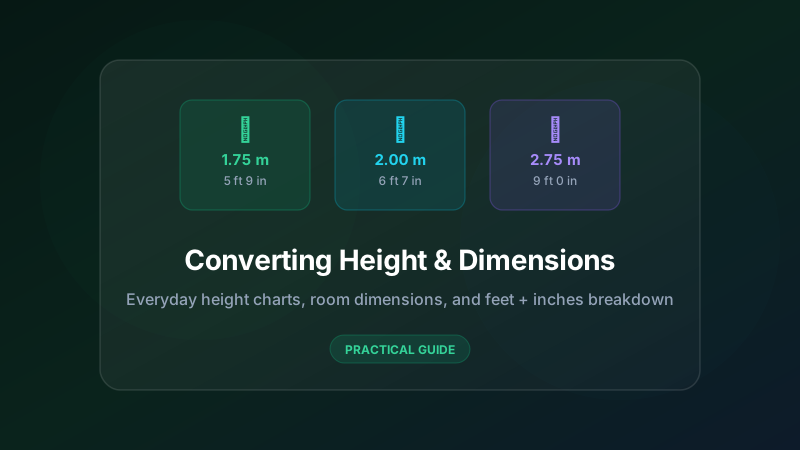
When buying furniture, booking flights, or traveling abroad, you frequently encounter heights and room dimensions specified in meters instead of feet and inches (or vice versa). Understanding these real-world benchmarks helps you visualize sizes instantly without getting bogged down in arithmetic.
Human Height Benchmarks
In many countries, personal height on passports and medical records is recorded in meters or centimeters. Here are the most common height equivalents:
- 1.60 m (160 cm): 5 feet 3 inches (5’3“)
- 1.65 m (165 cm): 5 feet 5 inches (5’5“)
- 1.70 m (170 cm): 5 feet 7 inches (5’7“)
- 1.75 m (175 cm): 5 feet 9 inches (5’9“) — Average adult male height in many regions
- 1.80 m (180 cm): 5 feet 11 inches (5’11“)
- 1.83 m (183 cm): Exactly 6 feet 0 inches (6’0“)
- 1.85 m (185 cm): 6 feet 1 inch (6’1“)
- 1.90 m (190 cm): 6 feet 3 inches (6’3“)
Standard Architectural & Room Dimensions
Architecture plans often list ceiling heights and doorway clearances in meters:
1. Standard Doorway Height
- Metric: 2.00 meters to 2.10 meters
- Imperial: 6 feet 7 inches to 6 feet 11 inches (Standard 80-inch door is 2.032 m)
2. Standard Ceiling Height
- Metric: 2.40 meters to 2.70 meters
- Imperial: 8 feet (2.44 m) to 9 feet (2.74 m)
3. Kitchen Countertop Height
- Metric: 0.90 meters (90 cm)
- Imperial: 36 inches (3 feet)
Mental Math Shortcut for Fast Estimates
When you need an immediate ballpark figure while shopping:
- Multiply the meters by 3
- Add 10% of the result
- Result is very close to decimal feet!
Example for 4 meters:
- 4 × 3 = 12
- 10% of 12 = 1.2
- Estimate:
12 + 1.2 = 13.2 feet(Exact:13.123 feet) — error is less than an inch!